
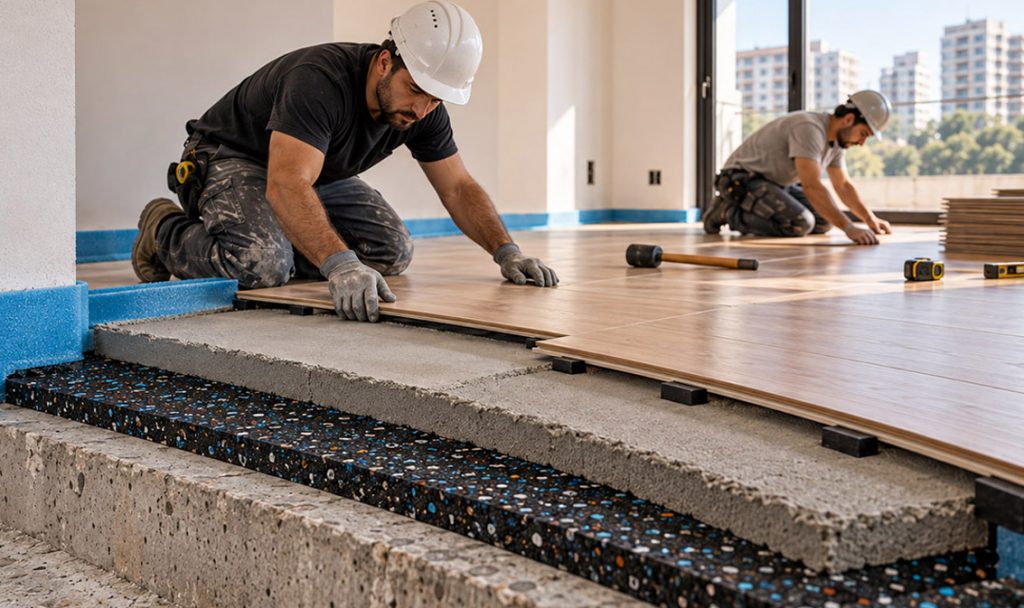
With all the demands taken place after the implementation of ABNT NBR 15.575/2013, the Brazil undergoes a new stage on the execution of residential buildings. However, it cannot be always perceived that the labour force has adapted to this new reality and, on what concerns acoustic aspects, those difficulties are fairly evident. The lack of qualification of the labour force in an acoustic solution can interfere directly in the quality of specific systems, as it is clearly observed in the noise attenuation of flooring with disconnection overlays. With the aim to identify and assess the intervenient variables in the process of the execution of flooring with disconnection overlays, a case study was undertaken in five construction sites, with the assembling of three different flooring systems. Subsequently, it was measured the weighted noise pressure levels of standardized impact for each of the systems built, according to the norms procedures ISO 140-7 and 717-2. The obtained outcome was compared to the performance expectations released by the overlays producers. Discrepancy was noticed in the performance of the same overlay installed in different construction sites; also many outcomes did not reach the expected result as their producers’. The detailed analysis of the overlay installation process allowed the identification of labour flaws as the main source of attainment loss. It was also observed that the executive details were not adequately followed, due to the procedures adopted on the constructive process management. The work undertaken shows the importance of labour capacitation and the attention to the constructive process stages to reach the desired acoustic outcomes, therefore contributing to the improvement of the flooring systems installation.